-

Paul Pfeiffer and Akram Zaatari: Group Exhibition, Regen Projects,
Regen Projects is pleased to present a group exhibition of video works by John Bock, Keren Cytter, Paul Pfeiffer, Gillian Wearing, and Akram Zaatari. This presentation marks the first time many of these works will be shown in Los Angeles.
John Bock’s Dandy (2006) was filmed at the family home of Henri de Toulouse Lautrec, the Chateau du Bosc. The video stars Monsieur Lautréamont, a character akin to Lautrec, who is willing to transgress traditional taste in the pursuit of aesthetic perfection. It is both period drama and surreal fantasy, featuring the artist as actor, and sculptural props resembling Bock’s work outside of the moving-image medium. Bock was recently included in The Encyclopedic Palace at the 55th Venice Biennale, and will have a major solo exhibition at the Bundeskunsthalle in Bonn, Germany (October 3 – January 12, 2014).
For Untitled (2009), artist Keren Cytter used both trained and untrained actors to shoot in front of a live audience at the Hebbel am Ufer theater in Berlin. Inspired by John Cassavetes’s Opening Night (1977), the film follows a theater actress as she prepares to go on stage and is confronted by the constructed nature of identity and reality. Her backstage ‘monologue’ resonates with the nature of role-playing and the performance awaited by the audience on the screen. Untitled was
last shown in Los Angeles during a one-person exhibition of Cytter’s work at the Hammer Museum in 2010. In addition to making video-based works, Cytter has published numerous novels, screenplays, journals and poems, and is the founder of the dance and theater company Dance International Europe Now (D.I.E. NOW).
Paul Pfeiffer’s Morning After the Deluge (2003) uses digital technology to create an illusion combining sunrise and sunset into a hypnotic projected image. The work takes its title from J. M. W. Turner’s painting from 1843, Light and Colour (Goethe’s Theory) – the Morning after the Deluge – Moses Writing the Book of Genesis, which depicts the dawn following the devastation of the biblical event. Both atmospheric and contemplative, Pfeiffer’s film is a rumination on the passing of time while suspending it indefinitely. Pfeifferis the recipient of numerous awards and prizes including the Bucksbaum Award given by the Whitney Museum of American Art (2000) as well as the Alpert Award for Visual Arts (2009). His work has been the subject of recent solo exhibitions at the Albright-Knox Gallery, Buffalo, New York in 2010 and the Blanton Museum of
Art, Austin, Texas in 2012.
The brief but powerful Bully (2010) by Gillian Wearing features Method actors engaging in an improvisational exercise in which an incident from the protagonist’s personal experience is reenacted. As the participants taunt and belittle the victim, painful memories emerge and emotions arise, blurring fact and fiction as roles and motivations become less clearly defined.
Bully was cut from the 83-minute documentary feature Self Made (2010), which was funded by the UK Film Council, and will be presented for the first time in Los Angeles. Wearing recently had a retrospective organized by the Whitechapel Gallery, London, which traveled to K20, Kunstsammlung Nordrhein-Westfalen, Düsseldorf, Germany and Pinakothek der Moderne, Munich, Germany and will have a solo exhibition at Regen Projects in the fall of 2014.
Akram Zaatari’s The End of Time (2013) depicts a changing combination of two men enacting a cycle of seduction and indifference. Zaatari’s work explores aspects of representation, identity, intimacy, and desire and is informed by research on vernacular Middle Eastern photography and the functions of the archive. One of the founders of the Arab Image Foundation, which aims to locate and preserve photos from Arabic communities around the world, Zaatari’s work investigates how images and image-making affect notions of history and memory. Akram Zaatari represented Lebanon this year at the 55th Venice Biennale with Letter to a Refusing Pilot (2013) and is currently premiering in the United States two video installations at the Museum of Modern Art in New York.
-
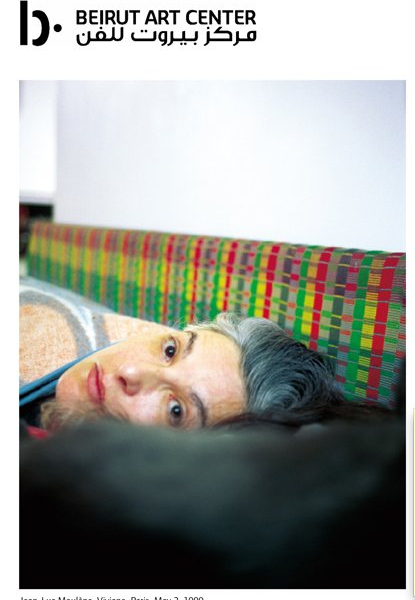
Jean-Luc Moulène: Works, Beirut Art Center
Beirut Art Center is pleased to present a solo exhibition by French artist Jean-Luc Moulène.
Known as a photographer, particularly for his series Objets de grève (2000-2003) and Produits de Palestine (2002-2004), Moulène's documentary approach to photography has participated in questioning the function of the image and its politics, as well as the relations between the photographer, the subject, and the spectator. Since the late 1990s Moulène has become more and more engaged in the production of objects and drawings, reacting to the increasing dematerialization of labour. That being said, there is no definite boundary between image and object, and the artist continues to use photography as a research tool.
This exhibition is Moulène's first solo show in Lebanon; yet, his experiences in the country started more than a decade ago. Moulène travelled to Lebanon in 1999 and 2002, producing a body of images in the city of Saida. This photographic series consists of landscapes, as well as portraits of individuals whom the artist met and got to know during his stay in the city. These images were printed in large format (2 x3 m) and hung on the walls of the old city, evoking the complex relations between private and public space, and allowing the residents to appropriate these images in a gesture of restitution.
For this exhibition the artist will present works in different media, ranging from photographs, drawings with BIC ballpoint inks, objects, video, as well as a large scale structure especially produced for the show. While this exhibition is not a retrospective of Moulène's oeuvre, it nonetheless includes many key works that he created at different stages of his career. The exhibition unfolds in four parts. The first presents works that share a concern with the body in relation to personal and public space. The second leads us to think about production means and processes focusing on the notion of "standard." The objects included in the third part are carefully handmade and put in dialogue with photographs considered by the artist as "documents." Finally the exhibition ends with a series of drawings and a video that make use of observations and performative gestures to rethinking the mundane.
Stemming from the 1970s' notion of art as an enigma, Moulène's approach is disjunctive, dismissing clearly defined ideas and addressing multiple themes. In these exhibited works the artist confronts the viewer with the standard and the singular, as well as the performative aspect of identity formation. Moulène's concern is also "to authorize rather than to be an author," to show tensions and conflicts, affirmations and negations in the systems that govern our lives from economy to culture. The artist can be said to produce tricks for truth, or artefacts and spaces for the sake of experimentation with options and choices. In this sense, many of his works are conjugated in the future tense, pointing to a possibility, a potential for subversion that may or may not be realized.
-
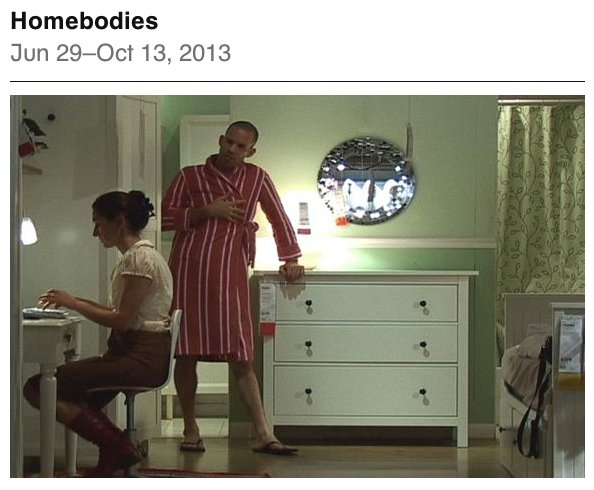
Alexandre da Cunha and Hurvin Anderson: Homebodies, Museum of Contemporary Art, Chicago
Homebodies presents work by contemporary artists who examine the space of the home, both literally and metaphorically, as an integral site for making art. Featuring an expansive range of artworks, some made of materials found in the domestic sphere and others that represent or re-create a sense of domesticity, Homebodies demonstrates a new understanding of how the domestic context has influenced the creation and interpretation of contemporary art. The exhibition incorporates various media, including paintings by Hurvin Anderson; sculptures by George Segal and Rachel Whiteread; installations by Alexandre da Cunha and Do Ho Suh; photography by Marina Abramović, Barbara Kruger, Doug Aitken, and Adrian Piper; video by Martha Rosler, Rivane Neuenschwander, and Guy Ben-Ner; and a living-room environment by Dzine that doubles as a nail salon. The exhibition is likewise international in its reach, drawing from six continents to include more than forty artists at various stages in their careers.
The domestic setting has been a crucial site (and recurring subject) of artistic production-a parallel track and occasionally a counterpoint to more commonly celebrated contexts such as the artist's studio and the public sphere. In fact, many artists, for personal or financial reasons, work at home, and for those artists the home often becomes the subject and source of their artwork. Although this exhibition focuses on artists working from the late 1960s to the present, there are notable precedents in art history dating back as early modernism. Major artists in the nineteenth and early twentieth centuries, including Vincent van Gogh and Henri Matisse, frequently depicted domestic interiors as sites of psychological reflection and a potent metaphor for social or historical concerns. Later, in the 1970s, the feminist movement exposed the home as a site of identity production and interrogation, putting pressure on the presumably male cliché of the heroic artist creating alone in his studio. In recent years, as commerce and communication have become increasingly globalized, artists have paradoxically turned inward, examining the idea of "home" in more localized contexts, recognizing it as an arena of social development and an indicator of economic trends, especially as more and more artists confront the recent crises in housing and urban development in their work.
The exhibition is organized in three sections. The first, Architectonics, includes works that represent interiors, use fragments of private homes, or are produced on a small scale, often using humble, domestic materials. The second section, Division of Labor, presents artworks that replicate a "cottage industry" scale of production or refigure activities such as care and cleaning, and demonstrates the lasting impact of the feminist movement on artists of any gender expression. Finally, the third section, Psychogeographies, considers how private interiors can become a metaphor for interior mental spaces, oftentimes fraught with anxiety and upheaval.
This exhibition is organized by Naomi Beckwith, Marilyn and Larry Fields Curator at the Museum of Contemporary Art Chicago.
-
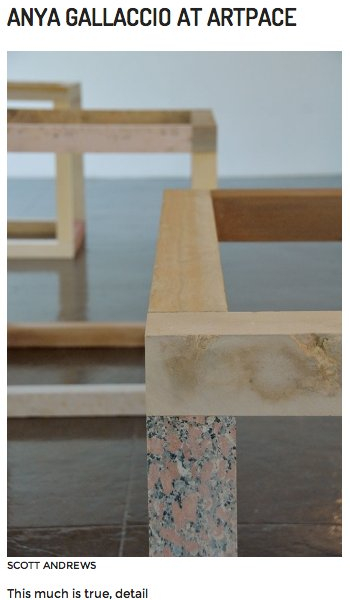
Anya Gallaccio: Artpace, San Antonio
Hudson (Show)Room: Anya Gallaccio
Anya Gallaccio returns to Artpace 16 years after her International Artist-in-Residence project with This much is true, an installation of four cubic sculptures at the Hudson (Show)Room.
-
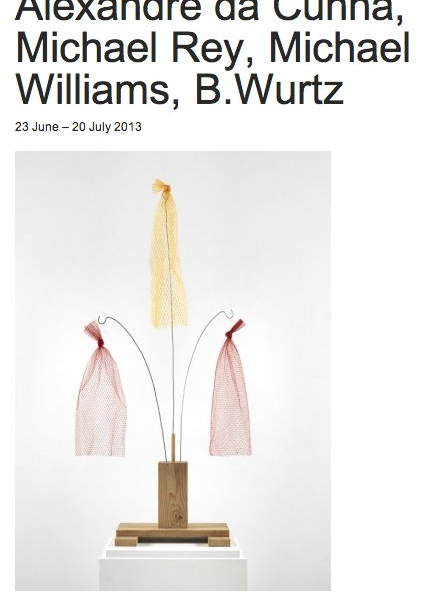
Alexandre da Cunha: Alexandre da Cunha, Michael Rey, Michael Williams, B.Wurtz, Office Baroque Gallery
Participating artists:
Alexandre da Cunha
Michael Rey
Michael WIlliams
B.Wurtz -
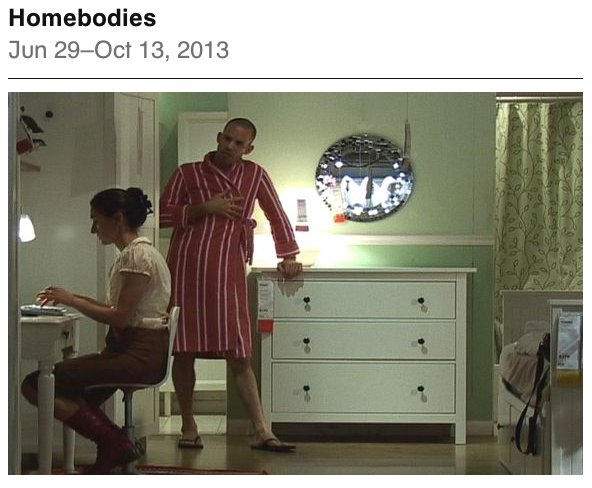
Alexandre da Cunha: Homebodies, Museum of Contemporary Art, Chicago
Homebodies presents work by contemporary artists who examine the space of the home, both literally and metaphorically, as an integral site for making art. Featuring an expansive range of artworks, some made of materials found in the domestic sphere and others that represent or re-create a sense of domesticity, Homebodies demonstrates a new understanding of how the domestic context has influenced the creation and interpretation of contemporary art. The exhibition incorporates various media, including paintings by Hurvin Anderson; sculptures by George Segal and Rachel Whiteread; installations by Alexandre da Cunha and Do Ho Suh; photography by Marina Abramović, Barbara Kruger, Doug Aitken, and Adrian Piper; video by Martha Rosler, Rivane Neuenschwander, and Guy Ben-Ner; and a living-room environment by Dzine that doubles as a nail salon. The exhibition is likewise international in its reach, drawing from six continents to include more than forty artists at various stages in their careers.
The domestic setting has been a crucial site (and recurring subject) of artistic production-a parallel track and occasionally a counterpoint to more commonly celebrated contexts such as the artist's studio and the public sphere. In fact, many artists, for personal or financial reasons, work at home, and for those artists the home often becomes the subject and source of their artwork. Although this exhibition focuses on artists working from the late 1960s to the present, there are notable precedents in art history dating back as early modernism. Major artists in the nineteenth and early twentieth centuries, including Vincent van Gogh and Henri Matisse, frequently depicted domestic interiors as sites of psychological reflection and a potent metaphor for social or historical concerns. Later, in the 1970s, the feminist movement exposed the home as a site of identity production and interrogation, putting pressure on the presumably male cliché of the heroic artist creating alone in his studio. In recent years, as commerce and communication have become increasingly globalized, artists have paradoxically turned inward, examining the idea of "home" in more localized contexts, recognizing it as an arena of social development and an indicator of economic trends, especially as more and more artists confront the recent crises in housing and urban development in their work.
The exhibition is organized in three sections. The first, Architectonics, includes works that represent interiors, use fragments of private homes, or are produced on a small scale, often using humble, domestic materials. The second section, Division of Labor, presents artworks that replicate a "cottage industry" scale of production or refigure activities such as care and cleaning, and demonstrates the lasting impact of the feminist movement on artists of any gender expression. Finally, the third section, Psychogeographies, considers how private interiors can become a metaphor for interior mental spaces, oftentimes fraught with anxiety and upheaval.
This exhibition is organized by Naomi Beckwith, Marilyn and Larry Fields Curator at the Museum of Contemporary Art Chicago.
-
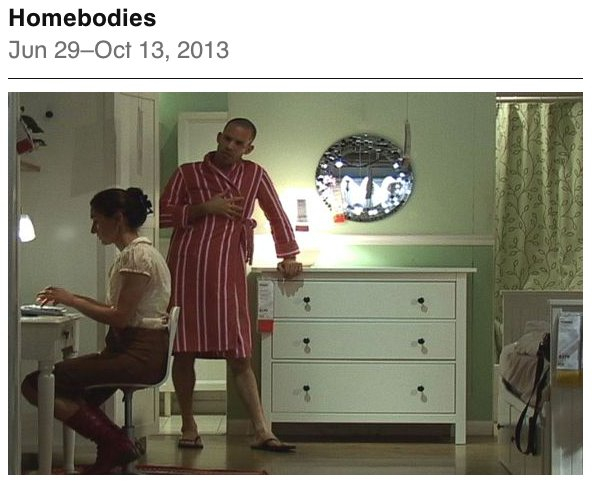
Hurvin Anderson: Homebodies, Museum of Contemporary Art, Chicago
Homebodies presents work by contemporary artists who examine the space of the home, both literally and metaphorically, as an integral site for making art. Featuring an expansive range of artworks, some made of materials found in the domestic sphere and others that represent or re-create a sense of domesticity, Homebodies demonstrates a new understanding of how the domestic context has influenced the creation and interpretation of contemporary art. The exhibition incorporates various media, including paintings by Hurvin Anderson; sculptures by George Segal and Rachel Whiteread; installations by Alexandre da Cunha and Do Ho Suh; photography by Marina Abramović, Barbara Kruger, Doug Aitken, and Adrian Piper; video by Martha Rosler, Rivane Neuenschwander, and Guy Ben-Ner; and a living-room environment by Dzine that doubles as a nail salon. The exhibition is likewise international in its reach, drawing from six continents to include more than forty artists at various stages in their careers.
The domestic setting has been a crucial site (and recurring subject) of artistic production-a parallel track and occasionally a counterpoint to more commonly celebrated contexts such as the artist's studio and the public sphere. In fact, many artists, for personal or financial reasons, work at home, and for those artists the home often becomes the subject and source of their artwork. Although this exhibition focuses on artists working from the late 1960s to the present, there are notable precedents in art history dating back as early modernism. Major artists in the nineteenth and early twentieth centuries, including Vincent van Gogh and Henri Matisse, frequently depicted domestic interiors as sites of psychological reflection and a potent metaphor for social or historical concerns. Later, in the 1970s, the feminist movement exposed the home as a site of identity production and interrogation, putting pressure on the presumably male cliché of the heroic artist creating alone in his studio. In recent years, as commerce and communication have become increasingly globalized, artists have paradoxically turned inward, examining the idea of "home" in more localized contexts, recognizing it as an arena of social development and an indicator of economic trends, especially as more and more artists confront the recent crises in housing and urban development in their work.
The exhibition is organized in three sections. The first, Architectonics, includes works that represent interiors, use fragments of private homes, or are produced on a small scale, often using humble, domestic materials. The second section, Division of Labor, presents artworks that replicate a "cottage industry" scale of production or refigure activities such as care and cleaning, and demonstrates the lasting impact of the feminist movement on artists of any gender expression. Finally, the third section, Psychogeographies, considers how private interiors can become a metaphor for interior mental spaces, oftentimes fraught with anxiety and upheaval.
This exhibition is organized by Naomi Beckwith, Marilyn and Larry Fields Curator at the Museum of Contemporary Art Chicago.
-

Lari Pittman: A Decorated Chronology, Contemporary Art Museum St Louis
CAM is proud to present the first American solo museum exhibition of Los Angeles-based artist Lari Pittman in more than 15 years.
Over the past three decades, Pittman has developed a body of work that is internationally celebrated for its exuberant use of color and painstakingly rendered detail to address such contentious subjects as sexuality, desire, and violence.
His multilayered depictions of images and signs-ranging from human figures and body parts to animals, plants, furniture, text, and even credit cards-meditates on the overwhelming richness and sadness of everyday life. Pittman's primarily large-scale paintings combine a visual breathlessness with a highly acute and sophisticated formal logic.
In recent years, his work has expanded in palette and also become more thematically oblique, exchanging the signature graphic imagery of his earlier paintings for greater visual density and a renewed concern for issues ranging from art history to the domestic sphere. Embracing the critical potential of figurative painting, Pittman provides incisive commentary on the medium's ability to intertwine the personal with the political.
CAM's exhibition will feature a selection of paintings and works on paper from the last 20 years and will be accompanied by a fully illustrated catalog.
Lari Pittman: A Decorated Chronology is organized by the Contemporary Art Museum St. Louis and curated by Kelly Shindler, Assistant Curator.
-
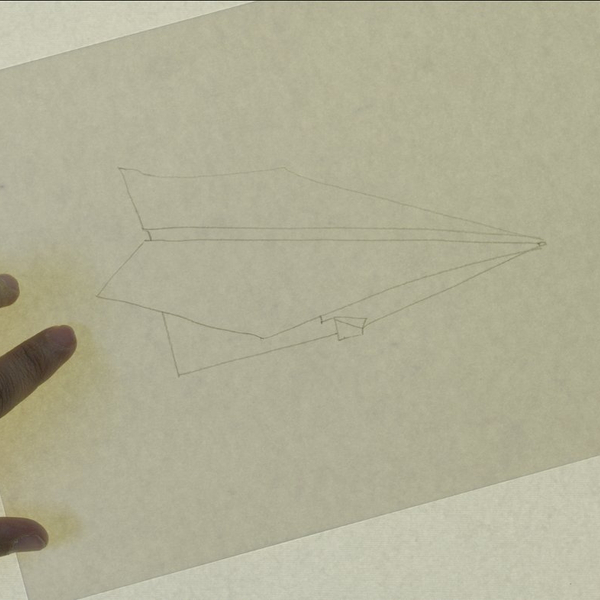
Akram Zaatari representing Lebanon at the 55th International Venice Biennale
Akram Zaatari
'Letter to a Refusing Pilot'June 1-November 24, 2013
Press conference: May 29, 2:30pm, Arsenale, Calle della Tana 2169/f
Professional preview: May 29-31Akram Zaatari will be presenting a major new work, titled Letter to a Refusing Pilot, in the Lebanese Pavilion at the 55th International Art Exhibition - La Biennale di Venezia. Curated by Sam Bardaouil and Till Fellrath, the exhibition marks the debut of Zaatari's most aesthetically ambitious and politically nuanced project to date, and creates a dialogue between two works, a new 45-minute video and a looping 16mm film, in an immersive environment conceived as a stage awaiting an actor, or a cinema awaiting a spectator.
In the summer of 1982, a rumor made the rounds of a small city in South Lebanon, which was under Israeli occupation at the time. It was said that a fighter pilot in the Israeli air force had been ordered to bomb a target on the outskirts of Saida, but knowing the building was a school, he refused to destroy it. Instead of carrying out his commanders' orders, the pilot veered off course and dropped his bombs in the sea. It was said that he knew the school because he had been a student there, because his family had lived in the city for generations, because he was born into Saida's Jewish community before it disappeared. As a boy, Akram Zaatari grew up hearing ever more elaborate versions of this story, as his father had been the director of the school for twenty years. Decades later, Zaatari discovered it wasn't a rumor. The pilot was real.
Pulling together all of the different strands of Zaatari's practice for the first time in a single work, Letter to a Refusing Pilot reflects on the complexities, ambiguities, and consequences of refusal as a decisive and generative act. Taking as its title a nod to Albert Camus' four-part epistolary essay "Letters to a German Friend," the work not only extends Zaatari's interest in excavated narratives and the circulation of images in times of war, it also raises crucial questions about national representation and perpetual crisis by reviving Camus's plea: "I should like to be able to love my country and still love justice."
Akram Zaatari
Akram Zaatari is an artist whose work is tied to collecting and exploring photographic practices in the making of social codes and aesthetic forms. Regarding the present through a wealth of photographic records from the past, Zaatari co-founded the Beirut-based Arab Image Foundation in 1997, and he has been working on the extensive archive of Hashem el Madani's Studio Shehrazade, in the Lebanese port city of Saida, since 1999. The author of more than 40 films and videos-including The End of Time(2013), Tomorrow Everything Will Be Alright (2010), Nature Morte (2008), In This House (2005), This Day (2003) and All Is Well on the Border (1997).Zaatari investigates notions of desire, pursuit, resistance, memory, surveillance, the shifting nature of political borders and the production and circulation of images in times of war. His works have been featured in dOCUMENTA (13) (2012), the Istanbul Biennial (2011), and the Venice Biennale (2007), among others, and he has shown his films, videos, photographs and other documents in institutions such as the Centre Pompidou in Paris, Tate Modern in London, Kunstverein and Haus der Kunst in Munich, Le Magasin in Grenoble, MUSAC in Leon, MUAC in Mexico City and Videobrasil in Sao Paulo.
Sam Bardaouil and Till Fellrath
Sam Bardaouil and Till Fellrath co-founded Art Reoriented, a multi-disciplinary curatorial platform operating from Munich and New York in 2009. Their past and ongoing exhibition, research and publication projects include collaborations with several museums and cultural institutions such as MoMA in New York, Mathaf in Doha, INHA and IMA in Paris, IVAM in Valencia, the Gwangju Museum of Art and the Today Art Museum in Beijing.Integral to Bardaouil and Fellrath's practice is the critique of institutionalized exhibition structures. Through their work, they question the way artworks have been appropriated by reductionist narratives and politicized modes of representation. They excavate art historical materials for the purpose of repositioning them in the more dynamic framework of contemporary artistic production.
-
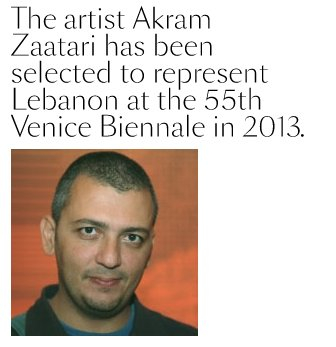
Akram Zaatari represents Lebanon at the 55th Venice Biennale 2013
Akram Zaatari was selected by the curators of the Pavilion Sam Bardaouil and Till Fellrath, the cofounders of Art Reoriented, the multi-disciplinary curatorial platform based in Munich and New York.
Akram Zaatari's work combines radio, television, and photographic archival material with his own personal narrative to examine the ideological circulation and geographic production of images in the context of the Middle East.
With a degree in architecture from the American University of Beirut (Lebanon) and a master's degree in media studies from the New School for Social Research, New York, USA, Zaatari explored the documental possibilities of video before making it his preferred medium of expression. He took his research into photography and collectionism as an artistic practice to new depths in the Arab Image Foundation, in Beirut, of which he is cofounder.
The Beirut-based artist has exhibited at such institutions as the Centre Georges Pompidou (Paris, France), Grey Art Gallery (New York), Munich Kunstverein (Munich, Germany), and MUSAC (León, Spain), as well as at the Turin Triennial (Italy) and the biennials of Venice (Italy), Sydney (Australia), and São Paulo.
Akram Zaatari has received widespread recognition in major institutions and exhibitions like Documenta 13 and has won the 2011 Yanghyun Prize and the 2011 Grand Prize Videobrasil.

Page
78
of 82